Posts on Research & Culture5 min readBy Lola · Published November 18, 2026
Turkey Tail and Chaga: What the Research on Functional Mushrooms Covers
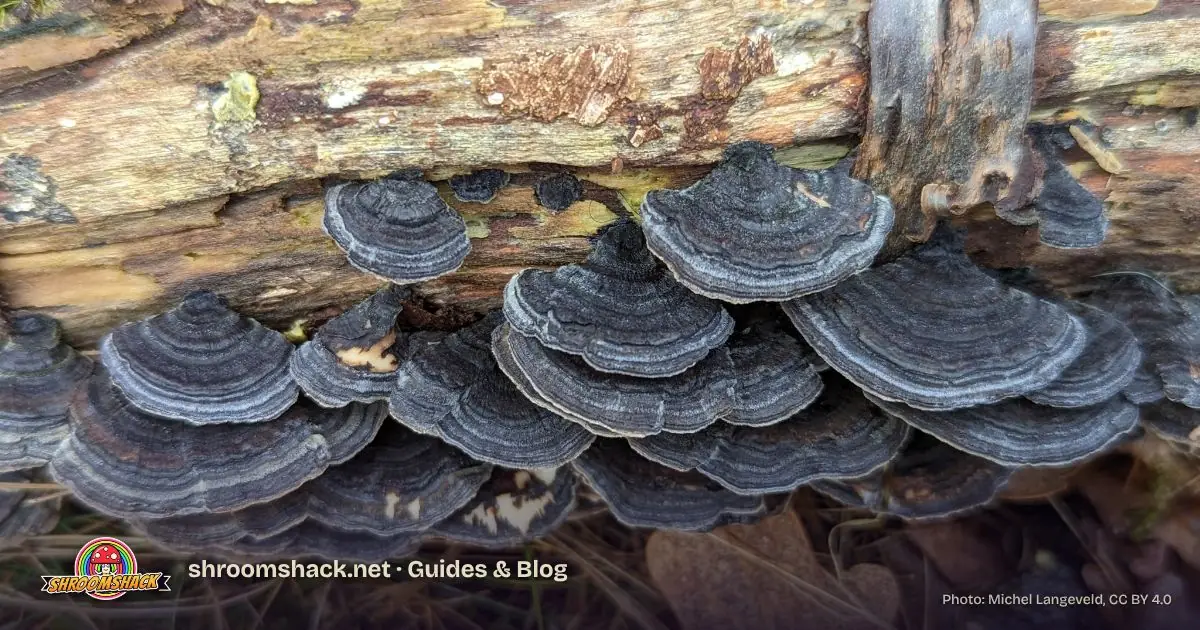
Walk down the supplement aisle of any health food shop and you will find turkey tail and chaga in powders, capsules, teas and coffee blends. Neither contains psilocybin, and neither causes any psychoactive effect. They belong to a separate group often called functional mushrooms, which our guide to functional vs magic mushrooms explains.
Both have long traditions of use, but their research records are very different. Turkey tail has decades of study behind it, including a purified extract used in Japanese hospitals. Chaga has a large body of laboratory work and very little in people. Here is what the research actually covers.
This is general information, not medical advice. Nothing here suggests that any food or supplement treats, prevents or cures any condition.
What turkey tail is
Turkey tail (Trametes versicolor, also called Coriolus versicolor in older papers) is a thin, leathery bracket fungus that grows in overlapping rings on dead wood around the world, including Canadian forests. Its banded brown, tan and grey colours give it its name. In Japan it is known as kawaratake, or "roof tile mushroom".
Most research focuses on two protein-bound polysaccharides extracted from it:
- PSK (polysaccharide-K, sold in Japan as Krestin), extracted from one particular strain.
- PSP (polysaccharopeptide), a related extract developed in China.
Both are highly purified, standardised extracts. That matters, because a study of an extract cannot simply be applied to a spoonful of whole mushroom powder.
What turkey tail research has measured
PSK has an unusual history. It was approved as a prescription drug in Japan in 1977, for use alongside conventional cancer treatment, and has been studied in Japanese clinical trials since. It has not been approved as a drug in the United States, and reviews describe the evidence outside that specific hospital setting as limited.
Two smaller studies give a sense of what researchers have looked at more recently.
- In 2012, Carolyn Torkelson and colleagues published a phase 1 trial in ISRN Oncology. Eleven women who had recently finished radiotherapy for breast cancer were recruited and nine completed the study, taking 3, 6 or 9 g of a turkey tail preparation a day for six weeks. The trial was designed to test tolerability. The authors reported that doses up to 9 g a day were tolerated and recorded changes in some immune cell counts, which they treated as exploratory.
- In 2014, Pallav and colleagues published a randomised study in Gut Microbes. Twenty-four healthy volunteers took PSP, the antibiotic amoxicillin or nothing, and gave stool samples over eight weeks. The authors reported that PSP produced consistent changes in the make-up of gut bacteria, which they described as a prebiotic effect. They also noted that each person's own baseline was stable and larger than the effects of either treatment.
Neither study tested whole turkey tail powder, and neither was designed to show a health outcome. They show what researchers are measuring: tolerability, immune markers and gut bacteria.
What chaga is
Chaga (Inonotus obliquus) looks nothing like a typical mushroom. It forms a black, cracked mass on the trunks of birch trees in cold northern forests, including across Canada, with a rusty orange interior. It has been used as a folk tea in Russia and northern Europe for centuries.
What chaga research has measured
Chaga has been studied extensively in cell cultures and animals, where researchers have looked at its polysaccharides and other compounds such as betulinic acid, which it draws from birch. But laboratory findings do not tell us what happens in people, and well-designed human trials of chaga remain scarce. Reviews and medical references consistently describe the human evidence as limited.
The most detailed human reports on chaga are actually about safety:
- Chaga can be high in oxalate, and laboratory tests have found the amount differs between brands. In a 2020 case report in the Journal of Korean Medical Science, doctors described a 49-year-old man whose kidneys failed after he took chaga powder for a long period. They measured very high oxalate in the leftover product.
- In 2022, a case report in Medicine described a 69-year-old man who had been taking 10 to 15 g of chaga powder a day and developed acute kidney injury with oxalate crystals in the kidney. His kidney function recovered after treatment.
- Memorial Sloan Kettering Cancer Center's About Herbs reference notes that chaga may increase the risk of bleeding in people taking blood thinners such as warfarin.
Case reports describe individuals, not risks across a population, and these involved large amounts taken over long periods. But they are a good reason to stick to the amount on the label.
How to read functional mushroom labels
Because the research mostly involves specific extracts, labels are worth reading closely.
- Fruiting body or mycelium. The fruiting body is the visible mushroom; mycelium is the root-like network, often grown on grain. Many products contain both, and labels should say which.
- Whole powder or extract. Studies such as those on PSK and PSP use concentrated extracts, not whole powder, so the amounts are not comparable.
- Serving size. Follow the label, and take extra care with chaga if you have kidney problems or take blood thinners.
People with mushroom allergies should avoid functional mushrooms, and anyone who takes regular medication should ask a pharmacist before adding a supplement. Our guide to lion's mane, chaga and reishi covers several other species.
Turkey tail and chaga in our shop
We carry turkey tail and chaga as everyday ingredients, not as remedies. None of these contains psilocybin.
- Turkey Tail Mushroom Powder: 100 g of organic turkey tail, fruiting body and mycelium, from Stay Wyld Organics, for stirring into coffee, tea or smoothies.
- Chaga Mushroom Powder: 100 g of organic chaga, fruiting body and mycelium, from the same maker.
- Be Youthful (Booster) Mushroom Supplement Capsules: a capsule with turkey tail alongside tremella, shiitake and ginger.
- Be Energized (Booster) Mushroom Supplement Capsules: a capsule with chaga and reishi alongside Panax ginseng and ginger.
Sources
- Torkelson et al. (2012), Phase 1 Clinical Trial of Trametes versicolor in Women with Breast Cancer, ISRN Oncology
- Pallav et al. (2014), Effects of polysaccharopeptide from Trametes versicolor and amoxicillin on the gut microbiome of healthy volunteers, Gut Microbes
- National Cancer Institute, Medicinal Mushrooms (PDQ), Health Professional Version
- Lee et al. (2020), Development of End Stage Renal Disease after Long-Term Ingestion of Chaga Mushroom: Case Report and Review of Literature, Journal of Korean Medical Science
- Kwon et al. (2022), Chaga mushroom-induced oxalate nephropathy that clinically manifested as nephrotic syndrome: A case report, Medicine
- Memorial Sloan Kettering Cancer Center, About Herbs: Chaga Mushroom
- Cover photo: Trametes versicolor (turkey tail) by Michel Langeveld, CC BY 4.0, via iNaturalist
What the research says
- Trial of psilocybin versus escitalopram for depressionCarhart-Harris R, et al. (2021), New England Journal of Medicine.A 59-person, double-blind trial at Imperial College London compared two psilocybin sessions with six weeks of a common antidepressant.
- Percentage of heavy drinking days following psilocybin-assisted psychotherapy vs placebo in the treatment of adult patients with alcohol use disorderBogenschutz MP, et al. (2022), JAMA Psychiatry.A 93-person double-blind trial found fewer heavy drinking days over 32 weeks after psilocybin than after an active placebo.
- Pilot study of the 5-HT2AR agonist psilocybin in the treatment of tobacco addictionJohnson MW, Garcia-Romeu A, Cosimano MP, Griffiths RR (2014), Journal of Psychopharmacology.An open-label pilot in which 12 of 15 long-term smokers were abstinent six months later; small and uncontrolled, so a starting point rather than proof.
- Efficacy and safety of psilocybin-assisted treatment for major depressive disorder: prospective 12-month follow-upGukasyan N, et al. (2022), Journal of Psychopharmacology.Following the same participants for a year, the authors found the improvement lasted in many of them, with no serious adverse events.
Research on psilocybin is still young, and most trials give a measured dose with professional support. Results don't mean any product is safe or effective for you.
This guide is general information, not medical or legal advice. If you have health questions, talk to a health professional.
Your next step
Ready for your first trip?
Not sure where to start? Our starter kits are picked for first-timers. Free shipping across Canada on orders over $130.