Posts on Research & Culture6 min readBy Lola · Published November 26, 2026
Does Psilocybin Reduce Inflammation? What the New Research Shows
In October 2026, a short research letter in JAMA Psychiatry got far more attention than its size would suggest. Researchers at the University of California, San Francisco reported that people with Parkinson's disease had lower markers of inflammation in their blood after two psilocybin sessions. A reel by the Instagram creator @mushies_2 is how this study first reached us, and plenty of people have been asking about it since.
The finding is interesting. It is also early, small and easy to overstate. Below we go through what was measured, what a much larger review of the evidence says, and where the gaps are.
The Parkinson's study behind the headlines
The blood work came from a pilot trial the same UCSF team published in 2025. Twelve people with mild to moderate Parkinson's and depression or anxiety took part. Their average age was 63. Each person had one 10 mg dose of psilocybin and later one 25 mg dose, alongside psychotherapy. Nobody had a serious adverse event. The most common side effects were anxiety, nausea and a rise in blood pressure.
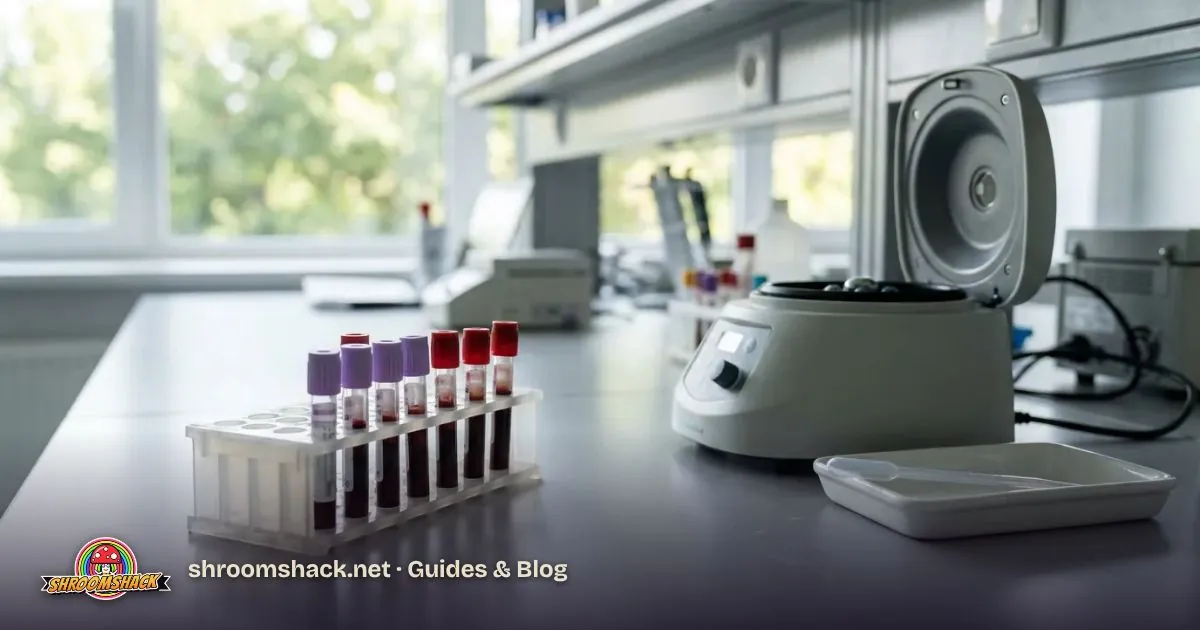
For the new letter, the researchers went back to blood samples taken before and after those sessions. They combined five inflammation markers into a single score. That score was lower after each session, and it was still lower a month after the final dose, according to NPR's report on the study. A separate marker of stress in mitochondria, the parts of a cell that make energy, dropped right after dosing but was back near its starting level at the one month check. Press coverage says blood from nine of the twelve participants went into the analysis. The full letter sits behind a paywall, so we haven't confirmed that number ourselves.
Psychiatrists from UCSF led the work, with scientists from Columbia University in New York and Imperial College London among the authors.
Why one small study can't settle it
The authors are open about the limits. There was no placebo group, so nothing shows the change wouldn't have happened anyway. Everyone knew they were getting psilocybin. Nine or twelve people is a very small sample, and blood markers often drift back toward normal between tests regardless of treatment.
Charles Nichols, a pharmacologist at LSU Health Sciences Center in New Orleans who wasn't involved, told NPR the study was "a proof of principle." That fits. Nichols co-wrote one of the first reviews proposing psychedelics as anti-inflammatory agents back in 2018, so he has followed this idea longer than most.
One more detail matters. The letter's funding came from Silo Pharma, a company developing psychedelic treatments, along with an anonymous donor. The authors state the funder had no role in the analysis. It is still worth knowing.
What happens when 61 studies are put side by side
Also in 2026, a team from UCSF and the University of Copenhagen in Denmark published the widest review of this question so far, in the journal Brain, Behavior, and Immunity. They screened more than 9,000 records and kept 61 studies: 24 done on cells, 30 in animals and 7 in humans.
The pattern they found is more interesting than a simple yes.
When inflammation had been triggered on purpose, psychedelics calmed it almost every time. Nineteen of 21 cell studies and all 24 animal studies of that kind reported an anti-inflammatory effect. In healthy animals with no inflammation to begin with, the picture flipped. Five of six such studies found psychedelics made inflammation markers go up.
Human data was thin and split three ways. Across ten trials, three found lower inflammation, three found higher and four found no clear change. The authors concluded there is too little human evidence to say what psychedelics do to inflammation in people. They also flagged signs of publication bias. Once they adjusted for it, the pooled effect shrank to the point where it couldn't be told apart from zero.
A separate review from Monash University's campus in Malaysia, published in 2025, looked at 40 lab studies and found the same two sided pattern. Psychedelics tended to ease inflammation that was already there and to promote it under normal conditions.
The one placebo controlled test in healthy people
The strongest human study so far comes from Maastricht University in the Netherlands, run with the UK's Beckley Foundation and researchers in Norway and Spain. Sixty healthy adults took part. Half had a single dose of psilocybin matched to body weight and half had a placebo.
On the day, psilocybin lowered TNF alpha, a key signal the immune system uses to switch inflammation on. A week later TNF alpha had returned to normal, but two other markers, IL 6 and C reactive protein, were lower in the psilocybin group. People whose IL 6 and C reactive protein dropped the most also reported the largest lasting lift in mood and social feeling.
That study had a placebo group, which the Parkinson's work lacked. It was still one study, in healthy volunteers, with changes measured over a single week.
Why researchers care about inflammation and mood
The interest here goes beyond Parkinson's. A 2019 review led by the University of Cambridge pooled 37 studies covering more than 13,000 people with depression. About one in four had low grade inflammation, judged by C reactive protein levels above 3 mg/L. More than half had at least mildly raised levels.
That is why some researchers wonder whether part of psilocybin's effect on mood could run through the immune system, alongside the brain changes we cover in our post on psilocybin and depression research. Nobody has shown that yet. It is a question being tested, not an answer.
It also connects to work on brain diseases. Inflammation plays a part in conditions such as Alzheimer's, which is one reason our upcoming psilocybin and dementia research post lists it among the leads researchers are following.
Our advice if you live with Parkinson's or another inflammatory condition
We suggest reading this research as a reason for hope in science, not as a reason to change your treatment. Please don't stop or swap any medication because of these results. Talk to your neurologist or family doctor first, and tell them about any mushroom use, even occasional.
The Parkinson's pilot happened with medical screening, measured doses and therapists in the room. Even there, anxiety and raised blood pressure were among the most common side effects. Psilocybin can also interact with common medications, which our psilocybin and medications guide covers in detail.
If you want to be part of the research, clinical trials are the safest route. In Canada, medical access to psilocybin goes through Health Canada's Special Access Program or an approved trial, as our guide to psilocybin in Canada explains. For other conditions now being studied, see psilocybin research beyond depression.
Where this leaves us
Lab and animal work suggests psychedelics can calm inflammation that is already running high. One placebo controlled study in healthy people and one small open study in Parkinson's both saw some markers fall. The larger review is clear that human evidence is still too limited to call psilocybin anti-inflammatory. We will update this post when a controlled trial reports.
Sources
- Bradley, Kelley et al. (2026), Psilocybin and Inflammatory and Mitochondrial Stress Markers in Parkinson Disease: A Nonrandomized Clinical Trial, JAMA Psychiatry
- Bradley et al. (2025), Psilocybin therapy for mood dysfunction in Parkinson's disease: an open-label pilot trial, Neuropsychopharmacology
- Lerche et al. (2026), Are psychedelics anti-inflammatory? A systematic review and meta-analysis, Brain, Behavior, and Immunity
- Mason et al. (2023), Psilocybin induces acute and persisting alterations in immune status in healthy volunteers, Brain, Behavior, and Immunity
- Low et al. (2025), The immunomodulatory effects of classical psychedelics: a systematic review of preclinical studies, Progress in Neuro-Psychopharmacology and Biological Psychiatry
- Flanagan and Nichols (2018), Psychedelics as anti-inflammatory agents, International Review of Psychiatry
- Osimo et al. (2019), Prevalence of low-grade inflammation in depression: a systematic review and meta-analysis of CRP levels, Psychological Medicine
- NPR (21 October 2026), New human data hints at psychedelics' potential to combat inflammation
What the research says
- Trial of psilocybin versus escitalopram for depressionCarhart-Harris R, et al. (2021), New England Journal of Medicine.A 59-person, double-blind trial at Imperial College London compared two psilocybin sessions with six weeks of a common antidepressant.
- Percentage of heavy drinking days following psilocybin-assisted psychotherapy vs placebo in the treatment of adult patients with alcohol use disorderBogenschutz MP, et al. (2022), JAMA Psychiatry.A 93-person double-blind trial found fewer heavy drinking days over 32 weeks after psilocybin than after an active placebo.
- Pilot study of the 5-HT2AR agonist psilocybin in the treatment of tobacco addictionJohnson MW, Garcia-Romeu A, Cosimano MP, Griffiths RR (2014), Journal of Psychopharmacology.An open-label pilot in which 12 of 15 long-term smokers were abstinent six months later; small and uncontrolled, so a starting point rather than proof.
- Efficacy and safety of psilocybin-assisted treatment for major depressive disorder: prospective 12-month follow-upGukasyan N, et al. (2022), Journal of Psychopharmacology.Following the same participants for a year, the authors found the improvement lasted in many of them, with no serious adverse events.
Research on psilocybin is still young, and most trials give a measured dose with professional support. Results don't mean any product is safe or effective for you.
This guide is general information, not medical or legal advice. If you have health questions, talk to a health professional.
Your next step
Ready for your first trip?
Not sure where to start? Our starter kits are picked for first-timers. Free shipping across Canada on orders over $130.