Research & Culture6 min readBy Lola · Updated November 11, 2026
Sacred Mushrooms Around the World: What Each Culture Left Behind
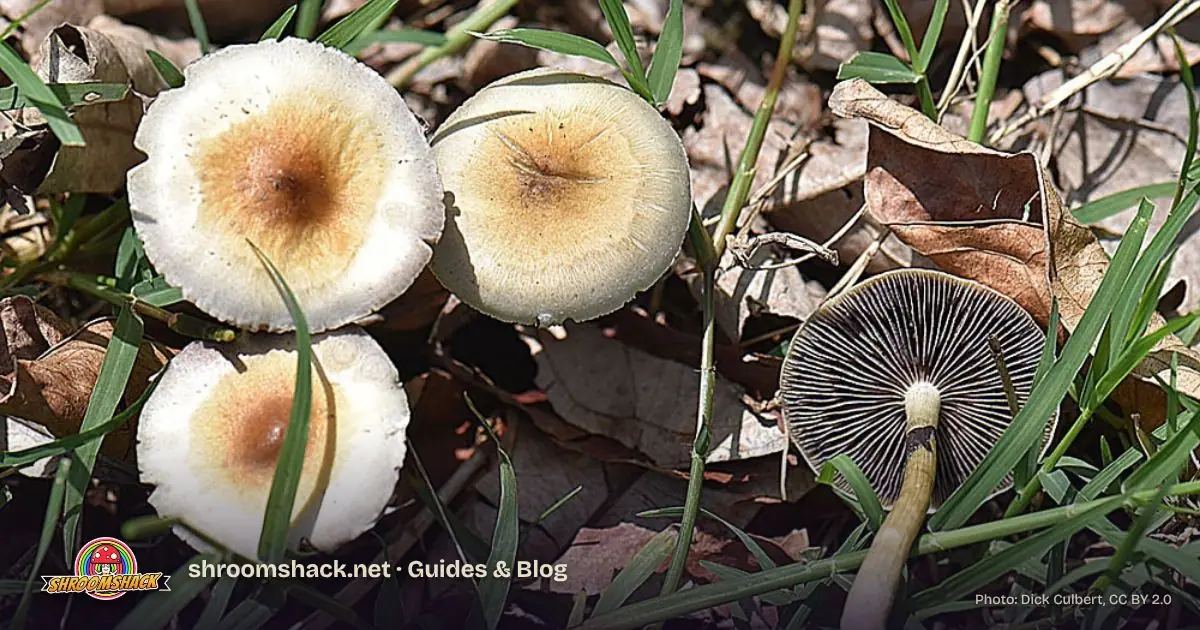
Psilocybin mushrooms grow on every continent except Antarctica. Mycologists have described more than 50 species in Mexico alone, with others across North America, Europe, Asia, Africa and Australia. Wherever they grow, people have met them, and some of those meetings left a mark.
This post travels around the world to look at that record. Some of it is firm, written down by people who saw the mushrooms used. Some of it is a careful guess from a painting on a rock. We say which is which, because the real history is interesting enough without stretching it.
Spain: a 6,000-year-old rock shelter
Near the village of Villar del Humo in Cuenca province, a rock shelter called Selva Pascuala holds a prehistoric painting first recorded in 1918. Among its figures is a row of small shapes that look like mushrooms.
In 2011 a team led by ethnomycologist Brian Akers argued in the journal Economic Botany that these shapes may show Psilocybe hispanica, a psilocybin mushroom that grows in the same region. The painting is commonly dated to about 6,000 years ago. The authors put their title as a question, and that is the honest way to read it. The shapes are suggestive, and the species that grows nearby is real. The intention of the painter is unknown.
Algeria: the Tassili figures
In the Tassili n'Ajjer mountains of the Sahara, Neolithic paintings show masked figures that appear to dance while holding mushroom-like objects. The Italian ethnobotanist Giorgio Samorini argued they may be the oldest known evidence of mushroom rituals, and the Mexican mycologist Gastón Guzmán suggested the shapes resemble African species such as Psilocybe mairei.
Other researchers have read the same shapes as arrowheads, oars or flowers. The famous "mushroom shaman" drawing that circulates online is not the original painting at all: it was drawn for Terence McKenna's 1992 book Food of the Gods by an artist working from a photograph, filling in parts she thought were damaged. The Tassili figures are a fascinating possibility, not proof.
Guatemala and Mexico: Maya mushroom stones
Hundreds of carved stone figures shaped like mushrooms have been found across the Maya region, most of them in Guatemala. R. Gordon Wasson saw them as evidence of a mushroom cult. Other archaeologists see them as effigies of a deity or link them to other rituals. They show that mushrooms mattered to the people who carved them. Exactly how is still debated.
The Aztecs: teonanácatl
Here the record becomes written. After the Spanish conquest, the Franciscan friar Bernardino de Sahagún worked with Nahua scholars to record Aztec life in what is now called the Florentine Codex, written between 1547 and 1582. It describes small mushrooms called teonanácatl, a Nahuatl word usually translated as "flesh of the gods", eaten with honey at feasts. Those who ate them danced, sang and wept, and some saw visions, which they took as signs of the future.
Spanish missionaries campaigned hard against the practice, which they saw as idolatry. For four centuries it went quiet in written records. It did not disappear.
The Mazatec of Oaxaca: a tradition that survived
In the mountains of Oaxaca, Mazatec healers kept the ceremony alive, out of sight. The anthropologist Jean Basset Johnson observed one in Huautla de Jiménez in 1938. In 1955, the Mazatec healer María Sabina allowed R. Gordon Wasson to take part in an all-night healing ceremony called a velada, and the outside world soon heard about it. We tell that story, and its cost to the Mazatec, in Wasson, María Sabina and Hofmann. For the Mazatec, the mushrooms were never about recreation. They were used to diagnose illness, find lost things and speak with the sacred.
Japan: the dancing mushrooms
The Konjaku Monogatari, a collection of more than a thousand tales written in Japan's late Heian period, about 900 years ago, includes a story that mushroom historians love. Woodcutters lost in the mountains meet a group of Buddhist nuns who are dancing and cannot stop. The nuns explain that they were hungry and ate some mushrooms they found. The woodcutters eat them too, and soon they are dancing as well.
The mushroom came to be called maitake, "dancing mushroom", and later waraitake, "laughing mushroom". Wasson wrote about the tale in the 1970s. Nobody knows which species it was. Today's maitake, the hen-of-the-woods sold in grocery stores, is not psychoactive, and researchers have suggested other candidates such as Panaeolus species. It is a folk tale, but it shows that people in Japan noticed what certain mushrooms could do.
Southern Africa: Basotho healers
The newest chapter comes from Lesotho and South Africa. In 2024, researchers from Stellenbosch University and citizen mycologists described two new psilocybin species in the journal Mycologia. One of them, Psilocybe maluti, is known locally as koae-ea-lekhoaba. Citizen mycologist Cullen Taylor Clark worked with Mamosebetsi Sethathi, a Mosotho traditional healer, to document how it is used in traditional healing practice.
According to the researchers, it is the first recorded first-hand report of hallucinogenic mushrooms being used traditionally in Africa. Later fieldwork describes healers using it in small amounts within herbal preparations, including in the initiation of new healers. It is a reminder that this history is still being written, and that much of it lives with people who have never been asked.
A note on Siberia
You will often read that Siberian shamans used "magic mushrooms". The mushroom in those accounts is fly agaric (Amanita muscaria), the red one with white spots. It contains different compounds (ibotenic acid and muscimol), works differently and carries different risks. It is part of the world's mushroom history, but not psilocybin's.
What this history tells us
Across all these places, the mushrooms were rarely taken casually. They were eaten at night, in ceremony, with an experienced healer or elder, often with music or chanting and a clear purpose. Modern researchers call this set and setting. Many cultures worked it out long before the term existed. Our set and setting guide shows how the same ideas apply today.
How to stay safe on magic mushrooms
- Never alone. Have a sober sitter you trust in the room for the whole experience.
- Who should not take mushrooms at all: anyone under 19, pregnant or breastfeeding, with a personal or family history of psychosis, schizophrenia or bipolar disorder, or with a heart condition.
- Medications. Lithium combined with psychedelics has been linked to seizures. MAOIs and tramadol carry serious risks, and antidepressants can blunt or change the effects. Read psilocybin and medications and talk to a doctor. Never stop a medication on your own.
- Start far lower. Know how your body responds to small amounts first, and wait at least two hours before even thinking about more.
- If it gets hard, our guide to handling a challenging trip explains what helps. Call 911 for chest pain, trouble breathing, a seizure, or anyone in danger.
- No driving, and remember psilocybin remains a controlled substance in Canada. Our safety guide has the full list.
Closer to home, First Nations in B.C. are setting their own rules for wild mushrooms. Read who looks after B.C.'s wild mushrooms.
For the modern chapter of this story, read a short history of magic mushrooms and Michael Pollan's How to Change Your Mind.
One modern chapter of this story began in a Boston chapel in 1962. Read the Good Friday Experiment, 25 years later.
Sources
- Akers et al. (2011), A Prehistoric Mural in Spain Depicting Neurotropic Psilocybe Mushrooms?, Economic Botany
- Tassili Mushroom Figure, Wikipedia (Samorini, Guzmán and the critics)
- Psilocybin mushroom, Wikipedia (species by region, Aztec and Mazatec use, Sahagún)
- Entheogenic drugs and the archaeological record, Wikipedia (Maya mushroom stones)
- Konjaku Monogatarishū, Wikipedia
- Grifola frondosa (maitake, "dancing mushroom"), Wikipedia
- Stellenbosch University (2024), Two new species of hallucinogenic mushrooms discovered in Southern Africa
- ScienceDaily (2024), New species of magic mushrooms discovered in Africa
- Cover photo: Psilocybe cubensis by Dick Culbert, CC BY 2.0, via Flickr
What the research says
- Trial of psilocybin versus escitalopram for depressionCarhart-Harris R, et al. (2021), New England Journal of Medicine.A 59-person, double-blind trial at Imperial College London compared two psilocybin sessions with six weeks of a common antidepressant.
- Percentage of heavy drinking days following psilocybin-assisted psychotherapy vs placebo in the treatment of adult patients with alcohol use disorderBogenschutz MP, et al. (2022), JAMA Psychiatry.A 93-person double-blind trial found fewer heavy drinking days over 32 weeks after psilocybin than after an active placebo.
- Pilot study of the 5-HT2AR agonist psilocybin in the treatment of tobacco addictionJohnson MW, Garcia-Romeu A, Cosimano MP, Griffiths RR (2014), Journal of Psychopharmacology.An open-label pilot in which 12 of 15 long-term smokers were abstinent six months later; small and uncontrolled, so a starting point rather than proof.
- Efficacy and safety of psilocybin-assisted treatment for major depressive disorder: prospective 12-month follow-upGukasyan N, et al. (2022), Journal of Psychopharmacology.Following the same participants for a year, the authors found the improvement lasted in many of them, with no serious adverse events.
Research on psilocybin is still young, and most trials give a measured dose with professional support. Results don't mean any product is safe or effective for you.
This guide is general information, not medical or legal advice. If you have health questions, talk to a health professional.
Your next step
Ready for your first trip?
Not sure where to start? Our starter kits are picked for first-timers. Free shipping across Canada on orders over $130.