Research & Culture4 min readBy Lola · Published November 11, 2026
Psilocybin vs Psilocin: What's the Difference?
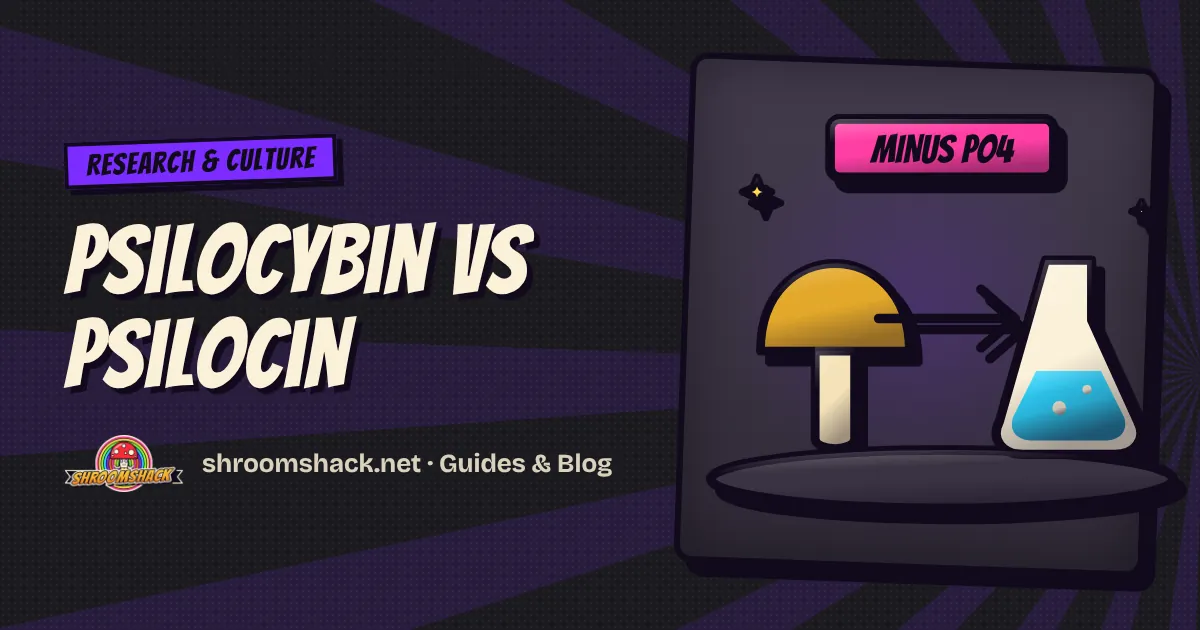
In short: psilocybin is the form stored in the mushroom. Your body strips one small piece off it and turns it into psilocin. Psilocin is the compound that acts on the brain. So the two are steps of the same process, not rival ingredients.
Both appear on every lab report for magic mushrooms, and both are named in Canadian law. Here is what each one is, how one becomes the other, and why it matters for storage, strength and drug tests.
What is psilocybin?
Psilocybin is a tryptamine, a close chemical cousin of serotonin. It carries a phosphate group, a small cluster of phosphorus and oxygen atoms. That group makes it stable. Dried mushrooms can keep most of their psilocybin for a long time when they stay dry and dark.
Albert Hofmann, the Swiss chemist who discovered LSD, isolated psilocybin from Mexican mushrooms in 1958 and made it in the lab a year later. Most clinical trials today use synthetic psilocybin in a capsule, so researchers know the exact amount.
What is psilocin?
Psilocin is psilocybin without the phosphate group. It is the compound that binds to serotonin 5-HT2A receptors in the brain. Those receptors drive the visual and emotional effects people describe.
Psilocin is much less stable. Air, light, heat and moisture break it down quickly. Mushrooms contain some psilocin of their own, often less than psilocybin, and the amount varies by strain and batch.
How your body turns psilocybin into psilocin
Psilocybin is what scientists call a prodrug. It does very little until the body converts it.
- You swallow the mushrooms, tea or capsule.
- Enzymes called phosphatases, mostly in the gut and liver, cut off the phosphate group.
- The psilocin that results enters the blood and reaches the brain.
- The liver then clears psilocin, mostly by attaching a sugar-like group to it so the kidneys can remove it.
This is why the onset takes time. Most people feel something after 20 to 60 minutes. Our guide on how long shrooms take to kick in covers the timeline for each format.
Is psilocin stronger than psilocybin?
Gram for gram, slightly, but only because it is lighter. The phosphate group adds weight. One milligram of psilocybin turns into about 0.72 mg of psilocin once the phosphate is gone. Researchers often treat the two as roughly equal in effect once that weight difference is counted.
So a lab report that lists both is giving you two parts of the same total. That is why many labs now report "total tryptamines" as well.
Why the difference matters
Storage. Psilocybin holds up well. Psilocin does not. A Czech study found dried mushrooms kept dark at room temperature lost the least, and fresh mushrooms lost the most, even in a deep freezer. Our guide to storing dried mushrooms puts that into practice.
Cooking. Heat speeds up the loss of psilocin. Long, high heat costs strength in an amount nobody can predict. See cooking with magic mushrooms.
Blue bruising. When a fresh mushroom is cut or squeezed, its psilocin reacts with air and turns blue. That colour is psilocin being lost, not a sign of extra strength.
Drug tests. Labs look for psilocin, usually in urine, because that is what the body produces. Standard workplace panels rarely include it. Our guide on drug tests and shrooms explains the windows.
Are psilocybin and psilocin legal in Canada?
No. Both are listed in Schedule III of the Controlled Drugs and Substances Act. Health Canada allows medical access only in narrow cases, such as the Special Access Program or a Section 56 exemption. Read psilocybin in Canada for the province by province picture.
Questions people ask
Is psilocybin the same as psilocin? No. Psilocybin is the stored form. Psilocin is the active form your body makes from it.
Which one is in magic mushrooms? Both. Most mushrooms hold more psilocybin than psilocin, and the mix changes with strain, drying and age.
Does psilocybin show up on a drug test? Tests look for psilocin. Standard panels usually do not check for it.
Why do magic mushrooms turn blue? Psilocin reacts with air when the mushroom is damaged. The blue is psilocin breaking down.
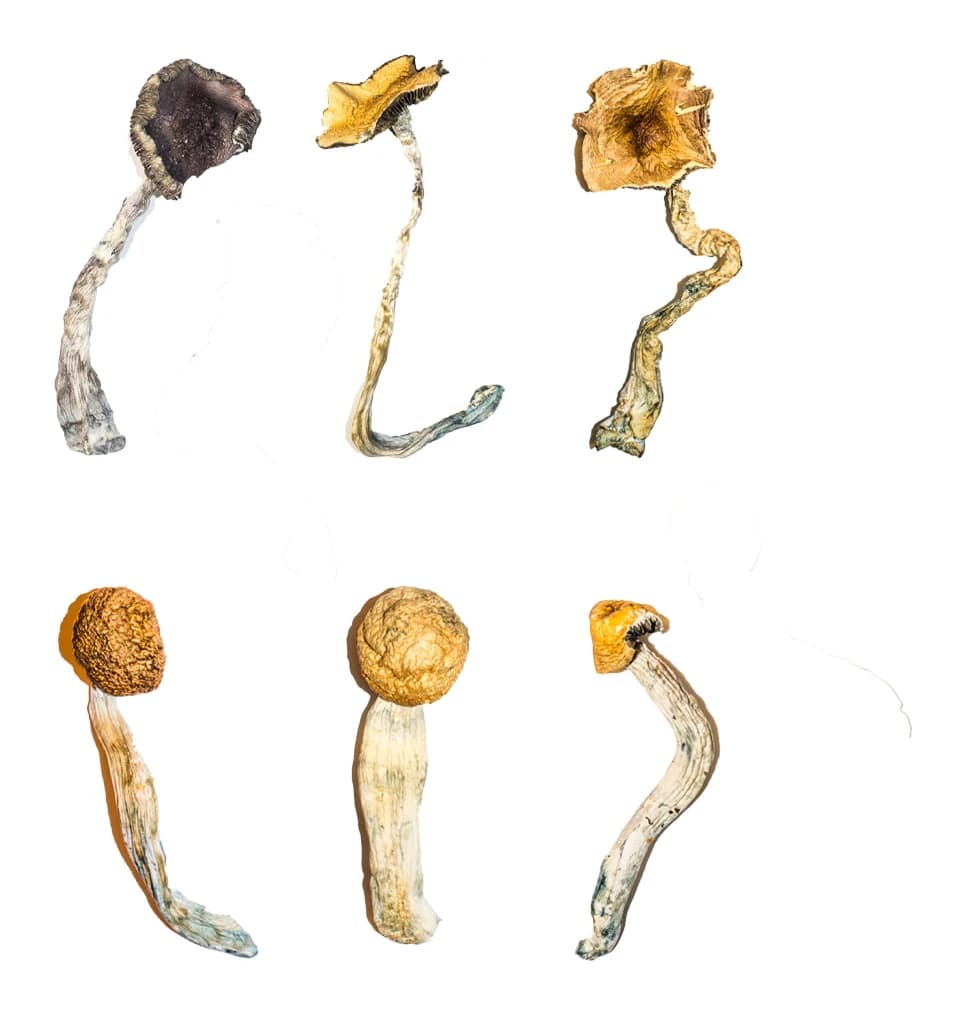
Want to see the mushrooms themselves? Our dried mushrooms list every strain we carry, with strength notes for each.
Psilocybin is a controlled substance in Canada, and nothing here is medical or legal advice. Skip it if you are under 19, pregnant, or have a personal or family history of psychosis or bipolar disorder. If you take any medication, read psilocybin and medications first. Our safety guide has the full list.
Sources
- Passie et al. (2002), The pharmacology of psilocybin, Addiction Biology
- Dinis-Oliveira (2017), Metabolism of psilocybin and psilocin: clinical and forensic toxicological relevance, Drug Metabolism Reviews
- Gotvaldová et al. (2021), Stability of psilocybin and its four analogs in the biomass of Psilocybe cubensis, Drug Testing and Analysis
- Lenz et al. (2020), Injury-triggered blueing reactions of Psilocybe "magic" mushrooms, Angewandte Chemie
- Health Canada, Psilocybin and psilocin (magic mushrooms)
- Controlled Drugs and Substances Act, Schedule III, Justice Laws Website
What the research says
- Trial of psilocybin versus escitalopram for depressionCarhart-Harris R, et al. (2021), New England Journal of Medicine.A 59-person, double-blind trial at Imperial College London compared two psilocybin sessions with six weeks of a common antidepressant.
- Percentage of heavy drinking days following psilocybin-assisted psychotherapy vs placebo in the treatment of adult patients with alcohol use disorderBogenschutz MP, et al. (2022), JAMA Psychiatry.A 93-person double-blind trial found fewer heavy drinking days over 32 weeks after psilocybin than after an active placebo.
- Pilot study of the 5-HT2AR agonist psilocybin in the treatment of tobacco addictionJohnson MW, Garcia-Romeu A, Cosimano MP, Griffiths RR (2014), Journal of Psychopharmacology.An open-label pilot in which 12 of 15 long-term smokers were abstinent six months later; small and uncontrolled, so a starting point rather than proof.
- Efficacy and safety of psilocybin-assisted treatment for major depressive disorder: prospective 12-month follow-upGukasyan N, et al. (2022), Journal of Psychopharmacology.Following the same participants for a year, the authors found the improvement lasted in many of them, with no serious adverse events.
Research on psilocybin is still young, and most trials give a measured dose with professional support. Results don't mean any product is safe or effective for you.
This guide is general information, not medical or legal advice. If you have health questions, talk to a health professional.
Your next step
Ready for your first trip?
Not sure where to start? Our starter kits are picked for first-timers. Free shipping across Canada on orders over $130.