Safe Use3 min readBy Shroomshack · Updated October 29, 2026
Shrooms and Alcohol, Shrooms and Weed: What Mixing Does
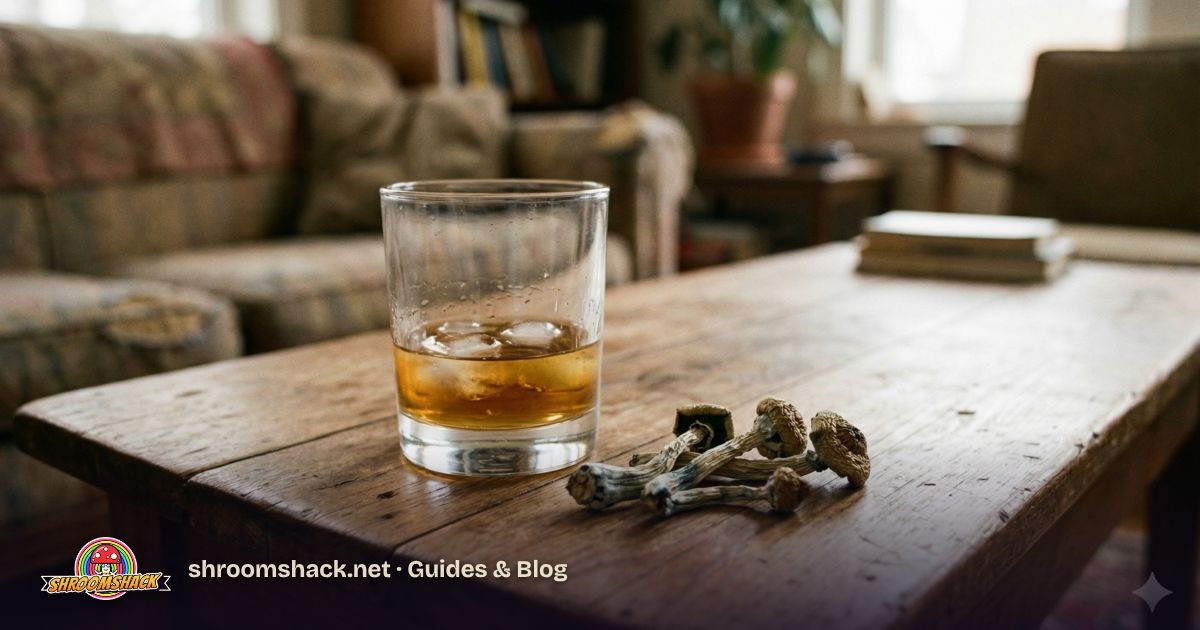
People ask about mixing more than almost anything else, and the answer is different for alcohol and for cannabis. Here is what the research and the large drug surveys actually show, and why most experienced people keep a mushroom day simple.
This is general information, not medical advice. If you take any prescription medication, read psilocybin and medications first.
Shrooms and alcohol
There is no well-known chemical interaction between psilocybin and alcohol of the dangerous kind seen with some medications. The problems are practical. Alcohol dulls coordination and judgment, and so does a mushroom experience, so the two together make falls, spills, arguments and bad decisions more likely. Alcohol also tends to make nausea worse, and the come-up of a mushroom experience already brings nausea for many people.
People also report that drinking muddies the experience. It can blunt or flatten the effects, which tempts some to take more mushrooms, and that is often where things go wrong.
Shrooms and weed
Cannabis is the substance most often combined with psychedelics, and it is the combination with research behind it. In a prospective online survey of 321 people published in 2022, those who used cannabis alongside a psychedelic reported more intense experiences, and the intensity rose with the amount of cannabis: stronger mystical-type feelings, more visual effects and more ego dissolution. The link with challenging experiences was not a straight line, and the authors point out that a survey cannot prove cause and effect.
In plain terms, cannabis rarely makes a mushroom experience milder. It tends to amplify it, sometimes in ways people did not plan for, especially with strong edibles or high-THC products.
What the emergency data says
The 2017 Global Drug Survey asked more than 9,000 people who had used magic mushrooms in the past year whether they had needed emergency medical treatment afterwards. Only 0.2% had. Of those who did, 37% had also used cannabis and 32% had been drinking in the same session, and mixing substances was one of the three reasons they gave most often, alongside being in the wrong mindset and the wrong place.
Shrooms vs weed vs alcohol
They are very different experiences. The effects of alcohol follow the amount you drink fairly closely. Cannabis varies widely with the product and its THC content. A mushroom experience lasts four to six hours, changes perception and emotion more deeply, and can't be cut short once it starts. That difference in length and depth is why a mushroom day needs more planning than a drink or a joint.
If you choose to combine
- Keep your first few mushroom experiences to mushrooms alone, so you learn how they affect you.
- If cannabis is part of your routine, wait until the peak has passed and start with much less than usual.
- Skip alcohol during the experience and drink water instead.
- Never drive, swim or go anywhere near traffic.
- Have a sober sitter. Read Trip Sitting 101.
Combinations to avoid entirely
Some combinations carry real medical risk, including lithium, tramadol, MAOIs and some antidepressants. Our medications guide lists them. Stimulants such as cocaine or MDMA add strain on the heart and are best kept far away from a mushroom day.
Not normal, and a reason to call 911: chest pain, trouble breathing, seizures, fainting, or anyone at risk of hurting themselves or others.
Learn more
Read set and setting, how long shrooms take to kick in and our safety guide. Skip psilocybin if you have a personal or family history of psychosis or bipolar disorder, a heart condition, are pregnant, or take lithium, MAOIs, tramadol or antidepressants without medical advice. You must be 19 or older to shop with us. Never drive after taking mushrooms. Psilocybin is a controlled substance in Canada.
Sources
- Kuc and others (2022), Psychedelic experience dose-dependently modulated by cannabis: results of a prospective online survey, Psychopharmacology
- Kopra and others (2022), Adverse experiences resulting in emergency medical treatment seeking following the use of magic mushrooms, Journal of Psychopharmacology
- Johnson, Richards and Griffiths (2008), Human hallucinogen research: guidelines for safety, Journal of Psychopharmacology
- Health Canada, Psilocybin and psilocin (magic mushrooms)
What the research says
- Survey study of challenging experiences after ingesting psilocybin mushrooms: acute and enduring positive and negative consequencesCarbonaro TM, et al. (2016), Journal of Psychopharmacology.A survey of nearly 2,000 people about their most difficult mushroom experience, and what made those experiences riskier or more meaningful.
- Harm potential of magic mushroom use: a reviewvan Amsterdam J, Opperhuizen A, van den Brink W (2011), Regulatory Toxicology and Pharmacology.A review for the Dutch government that rated dependence potential low, while flagging mixing with alcohol, setting and panic as the real concerns.
- Dose–response relationships of psilocybin-induced subjective experiences in humansHirschfeld T, Schmidt TT (2021), Journal of Psychopharmacology.A meta-analysis of how the strength of different effects rises with dose, across published studies.
- Pharmacokinetics of escalating doses of oral psilocybin in healthy adultsBrown RT, et al. (2017), Clinical Pharmacokinetics.Measured how quickly psilocin appears in the blood and how long it stays, which is why effects come on in under an hour and fade over several.
Research on psilocybin is still young, and most trials give a measured dose with professional support. Results don't mean any product is safe or effective for you.
This guide is general information, not medical or legal advice. If you have health questions, talk to a health professional.